By Gus Browning, printed in 73 Magazines in 1967-09
reprint by PA0ABM
Gus Browning story, Part 27
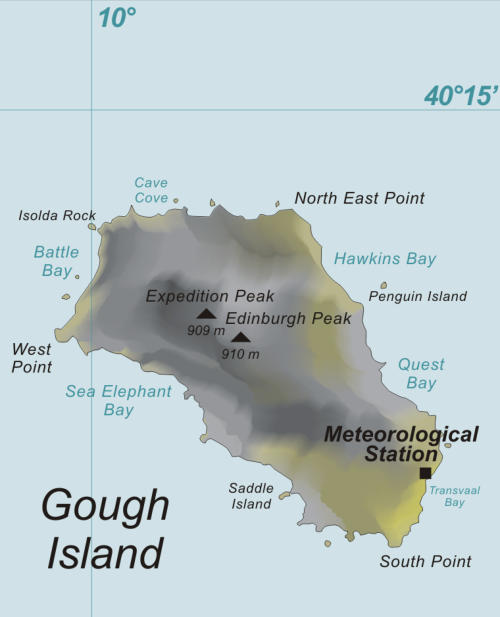
Gough Island
Away we were now for Gough Island, some 300 or 400 miles further south
towards that cold Antarctic continent. As we went south, a very noticeable
cooling off of the temperature was noticed, I spent many hours on the air that
night telling the fellows, "it won't be long now". We were going to be at Gough
Island for a number of days.
Late the next afternoon I again noticed the thickening of birds on the horizon
and about an hour later, Gough Island was in sight. It was almost a duplicate
of Tristan except the high plateau looked a bit higher and the mountains
seemed higher too. The birds were very numerous. Lots more than on
Tristan, At sundown we anchored a few miles offshore. The water was too
deep for anchors to do any good, so dining the night the engines were run
every now and then since we were drifting toward the island with no place to anchor. That was one night
the radar and depth finder came in handy. They were both watched closely all night.
I was on the air telling the fellows where we were and saying I hoped the next day to be on land so I
could give them a new country. I was very anxious to get on solid ground and get going with the
"Gus Watchers" as they called each other.
The next morning we went ashore to see the weather station which was located down Ui a deep
gulch between two mountains. It seemed like an odd place for a weather station to my way of
thinking. I guess they had come to the same conclusion, as we had three pre-fabricated buildings
on board which were to be unloaded at a spot about a mile south from the old station. The new
location was right smack on top of a fiat plateau, some 300 feet straight up from the water's edge. A
knocked down derrick was unloaded from the ship in pieces and this was to be walked to the spot
where they were going to build the new weather station. Eight men, 4 from the weather station and
4 from the ship, were going to walk that old, beat up J rusty derrick across that rough terrain. They
had a walkie-talkie with them to keep in touch with the ship's radio officer.
We all went back to the ship after looking around the island a little. We saw a number of seals, sea
elephants (very dirty looking animals), and a few penguins here and there down at the water's edge.
The penguins were rather wild and would head for the water when we approached. They would dive
under and not come up until they were far out to sea. The old sea elephant was groaning and
wailing away all the time and would snap at us if we got too close to him.
We had lunch on board the ship and then got in touch with the derrick crew to see how they were
progressing. They said it would take all the rest of that day just to get the parts of the derrick to the place
where it would be installed. I could see there would be no operating from land that night.
In order for the land crew to see where the ship was, they left the lights burning on board. This was a
bad thing to do, Around midnight a crew member knocked at my door and told me to come out on deck if
I wanted to see something unusual. Out we went and I saw the doggondest bloodiest sight I have ever
seen. There must be millions of night birds around Gough Island and they were attracted to the lights.
The lights were apparently blinding them as they were crashing into the shielded lights and the sides of
the ship. Birds were scattered all over the deck with broken necks, broken wings, some had their heads
knocked off. There was blood all over the place. It was very smelly and sickening to see those birds
slaughtering themselves. The next day the whole ship had to be hosed down from stem to stern and the
decks scrubbed to get rid of that fishy smell
They finally got the derrick put together about 4
PM but by now the wind had changed and it was
impossible to go ashore so I spent another night
aboard the ship. I know the guys were
disappointed and so was L Man, I was itching to
get on solid ground and operate rather than just
/MM,
Finally the next morning all was set and I was
given the opportunity to be the first one ashore.
We loaded the gear into the landing craft. All the
suitcases with the radio equipment were well
wrapped \\ith oil cloth that W8PQQ had sent me
months earlier, After a quick breakfast consisting
mostly of Rock Lobster ( I was beginning to get enough of that stuff by now), the landing craft was
lowered and away I went. As we approached those straight up cliffs, they looked higher and higher.
Finally I was right underneath them and they really did look high then.
We had the little walkie-talkie and called lip to the fellows with the derrick and told them to let her down.
Then sent down a big wire cage measuring about 12' x 12' with a veneer floor. This cage was opened up
and I, along with all my junk, was loaded inside. Then the cage was locked from the top and could not
be opened from inside. The signal was given from the top of the cliff to raise me up. Away I went. I was
at least on my way to good sohd giound, I wasn't too sure I was going to make it, though, I had noticed
that the steel cable on the derrick was quite rusty looking, and boy . . . what a lot of creaking and
groaning that thing made as it was being raised up. Here I was like a wild animal, locked inside a cage
being raised by a pre-historic looking derrick, on a strange island in the South Atlantic. Sometimes these
fellows on a DXpedition will do almost anything to give the guys a ''new c]ne'\ I am sure this DXpedition
would have come to a sudden stop if that cable had broken while I was being lifted ashore. Was I
afraid? You said it. Ole Buddy, I was!
And that is putting it mildly too.
On the way up, I had a chance to notice all the
bird caves in the side of the cliff. There seemed
to be a million of them. In each one, there was a
bird or two and they looked out at me and let out
a few squawks as I went by. I waved at them just
to be sociable. When I was about halfway up, I
looked down at the ship. It looked very small and
far down, The wire cage sure would have made
a big splash if that cable had broken and had
sunk to the bottom of that rocky lagoon. For me,
it would have been "goodbye world".
It seemed to take forever to bring me to the top.
I guess it was really only a couple of minutes,
but it seemed much longer. When the cage finally reached the top it was swung away from the water
it was sure good to be over dry land again. I was lowered and stepped out of the cage as it was
unlocked. At last I was on solid land and the QSOs I was to have would count for the DXers again. The
men on shore were ail interested in what I was doing even though they could not understand why I went
to all that trouble just to put a ham station on the air from Gough Island. I explained to them that I could
use a little help in putting up my tent and erecting the 40 foot sail mast I had taken ashore. They all
pitched in and in a couple of hours I was ready to go,
I timed up the rig, did a little juggling of the lengths of the ground plane wires to get the SWR down. On
40 meters from 7000 to 7200 it was not higher than 1.2:1 and it was even better on 20 and 15. I had
found that by cutting two ground plane wires to resonance on each band, this was not hard to do. The
signals from ZS and LU sounded like locals. I had just finished tuning up on 14065 and didn't even sign
my call when Marge, ZS1EM tapped her key a few times just saying, "Gus?*' Back I came, and gave her
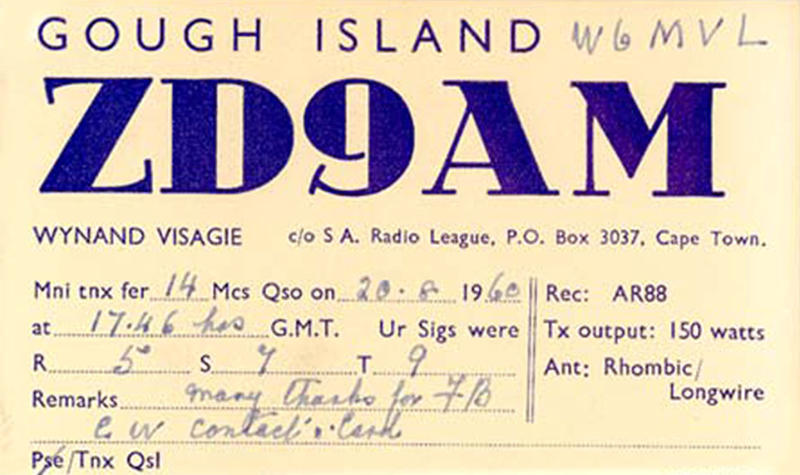
the first QSO from ZD9AM. She was 599 +. From then on, I worked them like mad. First a batch of ZS
stations and after them quite a number of LU's, PY's, and then all over Europe, After that the W/K
stations had their turn. It was like shooting doves in a baited field.
The band sure was in great shape considering the sun spots were down. In fact, the band came near to
staying open all night, ending with a few QSOs with VE8 and some KL7's. I could see things were going
to be very FB from this location and hoped they would continue the same when I got further south in a
week or so.
When the sun went down it got downright chilly, A damp southwest wind would start blowing and it felt
Uke it was coming directly from the South Pole to me. I had brought a pair of red insulated long handles
with me, so I stayed pretty comfortable.
The cooking chores were taken care of by the crew who were there to install the new weather station.
These South Africans are heavy eaters, and they took to the Rock Lobster like ducks to water. As for
myself, I got to the point where I didn't want that white meat all the time. That's when I began eating
some of the canned goods I had brought along with me. I did not think pork and beans could taste so
delicious and a few cans of those beans with little franks were "out of this world"!
I stayed up almost every night all night long and slept most of the day. Quite a nice wav for a fellow who
likes DXing as much as I do to spend the time. The funny part is, I never did get tired of this even though
after a while it took on the aspects of a "job". But it was an enjoyable Job, I must say.
The stay at Gough was supposed to have been for 3 or 6 days, since this was the time required to
assemble those pre-fab houses we brought from Capetown for the weather station and the staff. The
bad weather had not been considered at all in their plans. Every morning just at the break of day, the
sea looked very fine, but before the first barge could be filled with parts of the prefab buildings, the wind
shifted and increased to the point that landing the barge and loading UD the wire cage with material was
impossible. This thing kept up for 17 days. During this time they could only bring in a barge once in a
while. Fin ally ^ everything was ashore and put together and we were all glad it was over. I had just
about worked the bands dry and even had to call CQ two or three times to get a contact* When it gets
like this, it is time for a DXpeditioner to move on, and that is just what I wanted to do.
The night before the departure I got the message to be ready to depart from the island 30 minutes after
sun up the next day, I packed up all the equipment and got things torn down and was ready when the
ship sent the landing barge to pick me up from the wire cage. Again I took the trip in the cage and again
I was very much afraid the cable would break and end the DXpedition, But, I made it and was much
relieved to set foot on the barge safe and sound. I was sure glad to leave Gough Island and the birds
there.
There was some question about our going to Bouvet Island, since the Captain of the ship had been
requested to tow a disabled lobster boat back to Capetown, It looked as if Bouvet was going down the
drain until I contacted Brian— ZS6ANE, I asked Brian if he had any pull with the big man in Pretoria, He
told me not to worry and made a schedule for five hours later. When the sked time came, Brian was right
there and said he had good news for me. We were definitely going to Bouvet. This was confirmed by the
First Mate who told me we were now headed for the island after alL This was great news for me. I
immediately got on the air and told the fellows the news. Then I pulled the switch to the rig and
wandered up to the poop deck to chat with the man at the wheel. When I first entered, he told me we
had changed direction and were headed for Bouvet, which he called the land of ice and snow. He said I
had better have lots of warm clothing . . as much as I could walk in. He said it was the most unhealthy
and the coldest place in the world. He told me he wouldn't go there for a thousand dollars and I was in
for a rough time if I planned to land. I told him landing on Bouvet was the reason I had come on this trip
and nothing was going to stop me. This little talk with this man made me want to go there more than
ever. I like these challenges.
When the sun went down that afternoon, I went on deck to
watch the stars and I could see the Southern Cross had
risen a little higher in the sky. The winds became a little
colder and more brisk and the dark blue of the sky even
looked clearer and had a sort of cold look about it. The
waves were even more choppy than usual
Oh yes, before I forget, let me tell you of one incident
which happened while I was on Gough Island. After I had
been on the island a few days, three Russian Whalers
anchored a few miles from our ship. With field glasses we
could see they were watching us. The radio operator on our ship tried calling them a few times but
couldn't get any answer. After a while he called an imaginary group of American whalers supposedly
coming to Gough Island. He gave them a line about OK . , , we 'll be expecting five ships here tomorrow
morning. The result was the Russian ships departed before morning. So, you see, hams are not the only
ones who have QSOs with "ghost" stations. I remember one time when the band was dead and just for
the heck of it I called AC4YN and had a "QSO" with him. When I signed there were 5 stations calling
him. Two of them were fellows who were near the top of the DXCC Honor Roll, too! One of them called
me and asked me if AC4YN had come back to him! There are always interesting things on the band if
you listen for them.
Gus
Gus Browning, W4BPD

Hams - W4BPD - Gus Brwning 03