By Gus Browning, printed in 73 Magazines in 1966-12
reprint by PA0ABM
Gus Browning story, Part 18
VQ8C Chagos
In the last episode I was on my way to the Chagoes and the ill-fated /VQ8
operation.I use the term "ill-fated" loosely here since as explained in my last
episode I think I was about as legal as was possible at that time. I did not
know I was being stabbed in the back by a brother ham (the word ''brother" is
used loosely, too!). I hear over the air that Harvey Brain is thinking about
leaving VQ9. Well, let's wait and see about that before we ah—ah — ahh — -
. Anyway I was on the way to VQ8C and Ir had a FB trip there with my fish-
catching antenna.
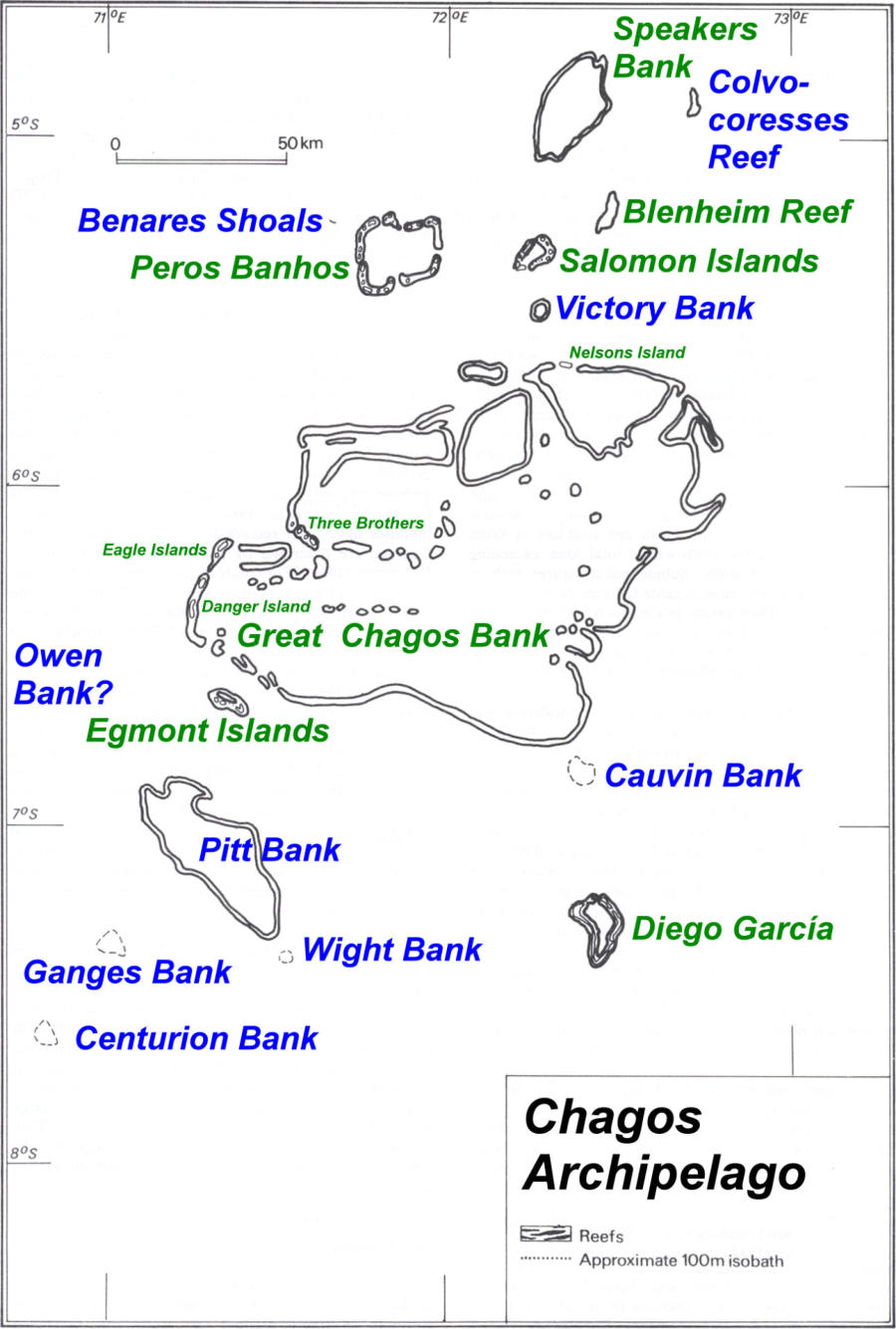
The Chagoes you know, consist of some 200 islands. We passed many very
small ones, each covered with coconut palms loaded with coconuts. Looking
at the captain's charts I could see that the ocean was very shallow in many
places so the captain had to do some real navigating. We landed at Diego
Garcia, an island some 20 miles long and a mile across. I was surprised to see how much work they had
done to make the loading of copra efficient. A long concrete dock projected out into the bay a few
hundred feet. The ship we arrived on was anchored out in the deep channel. Copra was boated to it
from the long pier. We went ashore and I presented my letter of introduction from the island's owner.
From then on I was treated as a guest— tea and crumpets any time and plenty of help to assist in
erecting my antennas, A shack was prepared for my use at the end of a very nice little walkway with
coconut trees on both sides. The shack was about half full of coconuts, and coming in at night presented
quite a challenge to keep from slipping all over the floor.
I met Leny's (ex-VQ8CB; now 5Z4GT) old friend Pi-Po, the operator
of the WX station. Pi-Po was a wonderful companion and everything
I asked him to do was done with a smile. He had been there for 20
years or so. He took me over to Leny's old house, and Leny's
operating table was still there. I actually saw where the key had
been screwed down. His house was empty and looked as if it had
been ever since Leny and his XYL, Lillette, had left some years
earlier. Pi-Po told me Leny had taught him his code and what
knowledge he had of radio. Leny did a good job, too, because Pi-Po
was a very good operator and not too bad a technician. Pi-Po made my stay on VQ8C very pleasant.
We met the owner of the island for a long chat the first night there. His hobby was underwater
pphotpography. He showed us his home-made waterproof camera holder, with all adjustments
protruding trough waterproof holes so he could make all necessary adjustments while underwater. Then
he showed us lots of underwater movies and a batch of color slides he had made of the waters around
the Chagoes, His camera work would have delighted even Hollywood. We talked and drank tea most of
the time. Some of the fellow s were drinking something a bit stronger. There were no Cokes there, so I
suffered in silence! They had a kerosine burning ice box so there was ice. The water was rather salty,
since the wells are not far from tire ocean, though they also had rain water from the roof tops which was
better. All die islands in the Indian Ocean use rain water. On Aldabra it's directed to a sort of little
swimming pool, and occasionally the) find a dead rat in the pool! Makes drinking this water a little rough
on you! Well, you gotta have water, you know ! I understand the manager of the Chagoes has left now
and I guess is back in Mauritius. I bet Pi-Po is still there, though, since he just looked like a fellow^ who
would never leave.
When I fired up at VQ8C all the gang were there QRX for me. On almost every QSO I was told "Gus,
you are a new one." It seemed as if all the QSO's that Leny had had when he was there, year after year,
had been wiped from everyonce's log, There was every chance in the world for the VQ8 authorities to
stop me while I was there because there is a twice-per-day schedule with the WX station at Mauritius. A
message to me
would have been
delivered minutes
after it was sent
because I saw Pi-Po
ten times each day
and our shacks were
not over 200 feet
apart. I don't think
anyone in VQ8
wanted to get me any
messages!
Before I left VQ9 I was told by them to be on that boat and not miss my chance of going to VQ8C.
Everyone knew the only reason I would go to VQ8C was to operate a ham station from the island. One
of these days someone will yet hit every one of those Indian Ocean islands and wring them out dry. That
is the day I will laugh my head off. Just as I have done in the AC spots with over 65,000 QSO's from
them; lots more than I have ever had from my 40 years of hamming from W4BPD, But still many have
asked me to return there for themI No one can work them all even when they work everyone on the air
from some spot. Two years later on it will he rare again. Look at Aldabra: two trips I was there with
something over 12,000 QSO's and still many need this one.
Now let me see where I was with my story. Oh yes, I was on Chagoes and we were having supper with
the island manager, who had two real nice looking "maids" for his own personal use. The supper was a
real feast: fish cooked about five different ways, coconut meat prepared a number of ways, turtle meat
and items brought ashore from the ship. We got a radio message the next day from Solomon Island that
a rainstorm that night had dumped over 15 inches of rain there in 10 horns. Now that's a rain for you! I
asked why most of the coconut trees on the Chagoes were so straight, and they explained that the
Chagoes were out of the cyclone belt and their prevailing winds were variable, so the trees had no
chance to get that permanent lean like on all the other islands I had seen. I I visited their copra works
and saw more doggoned coconuts than I thought there were in the world. They have very large concrete
rooms with no roof overhead, just a sliding roof that runs on old railroad tracks. They slide the roof back
and forth every few hours keeping the temperatue just right to cure the coconut meat into copra. They
told me that copra production on the Chagoes was the world's highest for the amount of land and
number of workers used in its production. They say their copra is the world's best since it's under a sort
of "quality controL"
The island manager was telling me about something that happened on
the island a few months before we arrived. One of the copra workers
came running to the manager's house one day saying he had some
"visitors" up on the north end of the island. The manager with a few of
his workers went up to investigate. A large black ship, with no flag or
markings was anchored a considerable distance out in the sea. He
estimated it to be about 350 ft. long. There were about a dozen
"visitors" walking all around the northern part of the island with machine
guns! They said they were studying bird life.
The manager asked them if they had any documents that indicated they were invited to come ashore.
They acted surprised that anything like this was necessary, and told him they would be leaving
sometime that afternoon. The big black ship was gone the next day. I have my own idea as to who it
was and what they were doing. You know the Chagoes are in a very FB spot for emergency aircraft
landings, and take-off's. Maybe some day someone will put an airfield there. Then it would be real easy
to get to VQ8C instead of a 10-day sail from VQ9 land. One day I was invited to go out sharking. The
boat was about 55 to 60 feet long and 12 feet wide, its hold being about 15
feet deep. Only three other people went along. We went in among a number
of small islands until we found the sharks. Let me tell you there were sharks
there; I mean by the hundreds or maybe even thousands. Two lines of 1/4
inch steel stranded wire with only one hook, about five inches long and
baited with a 1-pound piece of fish, were tossed overboard. The moment it
hit the water, bango, a 12foot shark grabbed the hook and the fun started.
The two fellows with their poles brought him up, lifted him into the boat— a
real he-man job, this—and threw him down into the hold of the ship. The
other fellow in the hold had a two-edged ax, and he chopped right into the
brains of the shark. Blood flew all over him and the inside of the hold the
shark quit flapping and the lines with that big hook were again cast over the
side of the boat— this time without any bait on the hook. Bango! Another
shark grabbed that bare hook. Up he came and over in the hold he went.
The fellow with that double bladed ax swung into the fish's brain and blood
flew. This kept up for four or five hours, until the boat was full of sharks. They
caught 253 sharks in that time, weighing about 5 tons. These fish are
brought ashore cleaned, dried and salted down and then shipped on to Africa where they are sold to the
natives. The natives, I was told usually eat this dried meat uncooked. I guess it's sort of like dried herring
that I have seen people eat even over here.
There is always something going on on these islands. If it's not one thing it's something else. There is
that stuff they get from coconut trees. It's a sort of white, milky fluid, and when it sits a few days they say
it has the kick of a mule. I have yet to go anyplace where strong drinks cannot be found. They always
find something to drink, you can be sure of that.
I wish this were true of Coca Cola, hi, hi.
Gus
Gus Browning, W4BPD

Hams - W4BPD - Gus Brwning 02