

By Gus Browning, printed in 73 Magazines in 1965-10
reprint by PA0ABM
Gus Browning story, Part 06
Auspice Day.
Well, boys, I was at the Radio Prague studio a few minutes before 9 am and
was taken in the big fancy studio and seated in front of the mike and told that
when the green light came on, I had one minute to get ready to go on the air
that when the red light came on, I was "on the air", to start talking. I am one
of those crazy fellows who just don't plan what I am going to say before I start
saying it. Here I was and as usual had made no plans at all on what I was
going to talk about. But I did make up my mind that if there were any
propaganda said into that mike , . , I would be the one to say it . . , and it
would be propaganda for me, and not them.
So on came the red light ... I was on the air. I started something like this, "My
name is Gus Browning, and I am from one of the poorest but nicest places in
the US, the little state of South Carolina. If you look at a map, you will see
that it is one of the smallest states in the US. I am not one of these rich
Americans you hear about, I am only just an average American, with 4
children and a nice wife. I have my own business, which is radio sales and
service, just a small business which I run myself. As far as the US is
concerned, I am sure that they have no idea where I am in fact, they don't
even care where I am. I suppose they feel it's none of their business where
I want to go. I decided two years ago I would like to make a trip around the
worlds so I saved my money and am now on that trip. The radio amateurs
here in Prague are treating me very nicely. I think radio amateurs the world
over always treat people nice because I think radio amateurs are the finest
people in the world-" Then I rambled on till my 15 minutes were over, I felt
that in my little way I had done a little propaganda for the US, and right over
Prague radio. Such remarks as saving enough money to make a trip around
the world in 2 years and that I am only an average American and that what I
do is my own business were read-between-the-lines propaganda. I figured
that listeners would be able to see from that how things were in the US.
One day I was walking down the streets of Prague and out of a clear sky a big Rolls Royce (it looked
like one to me) pulled up to the curb and blew its horn.
I nearly jumped out of my skin, because I thought
maybe he was trying to run me down, A big tall chap
stuck his head out the window and said, "Is that Gus
Browning, from Orangeburg, South Carolina?" I looked
closer at this fellow and said, ''Hello, John!" Then I
asked him what in the world he was doing here, and
his remark was, "The same as you: I wanted to see
what's behind the curtain." I hopped into his big fancy
car and we got to see lots of Prague together the next
couple of days, John had shipped his car to Munich
and had driven it to Prague along with his wife and
son, John (GW3ZV) had visited me in my home a few
years previously, that's why I knew him when he poked his head out of the car. Boy, it's a small world
when you meet someone from South Wales in the middle of Prague.
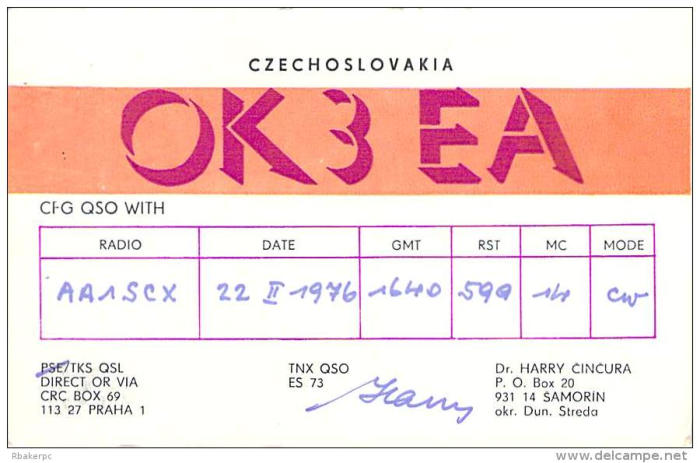
One night I had a telephone call from Harry, over in Bratislava, in the east part of Czech land. He asked
me to come over and visit him. I kind of beat around the bush (my money was not too plentiful). He said,
"Gus, I will fly over and pick you up and well both fly back here together," The next day Harry arrived,
bought me an airline ticket and we flew back to Bratislava together. Harry is a doctor and he was a very
fine host to me, taking me all around that area, and we met many of the OK3 boys. Harry's call sign is
OK3EA and there is no finer and more friendly fellow in all of Czechoslovakia, Harry bought me my
return ticket to Prague, I spent a few days again with Mirek OK1FF and with a very kind feeling towards
the Czech boys, I departed from Prague for Munich by train.
The trip was as usual very crowded train, people standing all over the aisles, good many police here and
there . . . then we arrived at the West German border . . and customs again. These boys meant
business they were making everyone dump their clothes out of the suitcases and they were searching
every pocket in every garment. Then I remembered a badge with a red star on it one of the OK fellows
had given me, and had suggested that I wear when leaving the country. I immediately put it on the lapel
of my coat. When the customs man got to me, I reached into my inside coat pocket and noticed the
customs man glancing at the red star badge on my lapel. I handed him my passport, and pointed to my
luggage overhead. He said, "0h, that's all OK' and without any further remarks to me, proceeded to the
next seat, still making everyone dump their suitcases like before. You know, I am still wondering if the
red star badge I had on my lapel had anything to do with my suitcase not being dumped and searched-
Maybe it was a coincidence he did not give me the big search like everyone else received. Or maybe I
had an innocent look on my face, or it may have been my "Auspice Day".
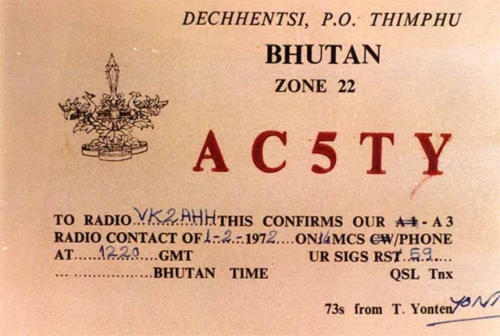
Now, that " Auspice Day" stuff reminds me that in this area of the world (I'm in AC5 land right now(
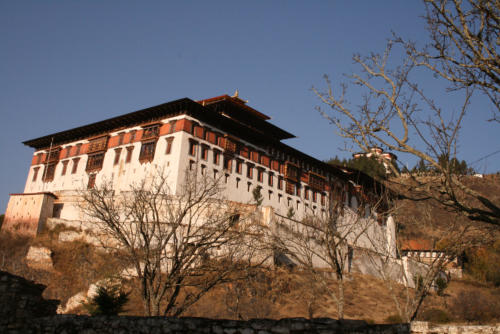
Bhutan,red)) nothing of real importance will be done unless it's your "Auspice Day". One of the Temple
(Dzong) priests who understands about the stars, planets, moon, sun, etc. tells them if the day is
"auspice" or not , . don't fool yourself, these people believe him, too, all the way from the lower caste to
the very top. Then it seems that they have another sort of "Un-auspice Day" , , . or something like that,
which causes them lots of trouble. We have all heard people say, "This is one of my bad days," or
maybe, "This is my day to shine," Well, there you go . . , "auspice or un-auspice."
Life here in Bhutan is very interesting. Occasionally I see a Bhutanese or group of Tibetans driving a
herd of yaks up one of the mountain passes. Then I see quite a nunber of Lamas coming or going from
the nearest Dzong. At night, I hear those big long Tibetan horns blowing, and some of those horns are
about twelve feet long and it takes three or four men to hold it up when it's being blown. These are the
most peaceful people I have ever seen.
I had just found out about Bhutan's biggest religious
celebration that's held each year over in Paro at the Paro
Dzong. I was asked if I would like to go over there and
witness this big celebration. I, of course, said yes, (I was
thinking about that being the AC6 portion of the country too!)
So on Monday we packed up the Jeep. Now, over here when
you go from one place to another, you just don't hop you have
to take under consideration. You take ALL your food, your
bedding (mattresses and all), you take your own cook and
bearer (this bearer is a sort of all-round servant), and of
course you take your radio gear, power plant, antenna. I also
invited my good friend Mani Kumar (the radio technician at
Dechen-Cholling) who is my constant companion and a real nice fellow. You try to picture us, four
people and all their bedding, food, and radio junk all to be carried in one small Jeep, When all that stuff
was out on the ground, it was a very big stack and to me looked absolutely impossible that all of this,
plus four people, could go on a Jeep, Well, after a lot of juggling, repacking, and cramming, we got it all
inside the Jeep and away we went.
The acting Signal Officer at Dechen-Cholling had sent a radiogram to the Signal Officer at Paro to take
care of us, and let me tell you, we really were taken care of in the very best of style. When we arrived
that afternoon I saw three brand new nice antenna poles all cut and trimmed, laying outside especially
for my use. They were cut a number of miles from Paro and carried by bearers to the station, I found out
that a room In the radio station had been completely rebuilt especially for me even a bed was made for
me (they don't use beds here since over 99% of the people sleep on the floor). A new kitchen was built
for my cook to use, and even some special food was on hand for ray use.
Everyone pitched in and helped me erect my Hy-Gain
14 AVQ vertical, which was installed on the very top of
a good straight sixty foot pole. Even digging a hole
here in Bhutan is a very tough job rocks are
everywhere. After two trial holes, we were successful
in getting a hole three feet deep where the largest rock
was no larger than my head. Remember that these
fellows were digging only with their large knives and
their hands to remove the dirt and rocks. Finally the
antenna was up, and I took out my compass to see
what was be- tween me and the US. I saw that due
north, about three miles away, there was a big
mountain, covered with snow, about 6,000 feet above
our altitude (we were about 8,000 feet). To the south
there was the Paro valley with the Paro river in its middle and rice paddies on each side. To the west
was a mountain, and to the east was a mountain . ... its mountains all around you, regardless of where
you are in Bhutan, and they are always higher than you are!
I operated during the night, the band folded up about 0300, I ate breakfast, and into the Jeep and go.
There are many things away to the Dzong I went to see the celebration, which lasted five days.
Inside the walls of the Dzong, people were sitting all around an open spot. There was not one other
Westerner there but me. I had secured permission from the Head Lama that I could take all the pictures
I wanted to. They had me a chair on hand to use, situated right in the middle of the crowd, at a nice spot
to see all the events as they took place* There were about 10,000 people in the crowd the first day.
All of a sudden, I heard the most unusual horn blowing, and up on the roof were two Lamas blowing two
big long Tibetan horns . . about fifteen feet long. These fellows all during the events acted as
"Introducers" to each event as it started.
There were lots of dogs present, and to control them and also people who got too close, there were a
few -. . , let's call them "crowd controllers" . , , who were really on the job all during the five days. These
fellows were really free with their whips, regardless of whether it was a dog or a person. Their whips
would strike out and whoever was in its path knew to move back. I must say these fellows kept
everything under control too! I was glad I was not on the front row!
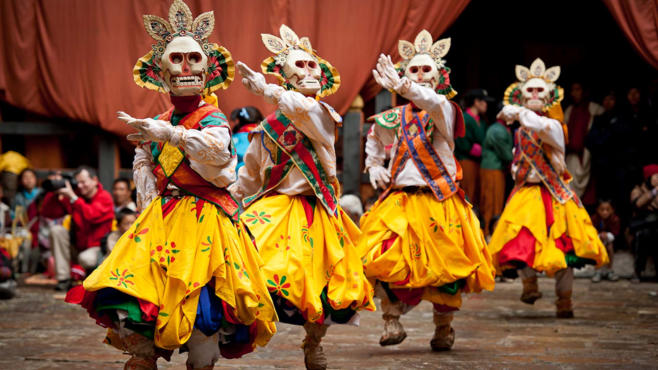
All during the events, there were about four red-masked clowns on hand to liven up things, and I would
like to tell you everything they did, but if I were really to describe everything, Wayne Green would be
arrested and sued for publishing such things. At times one or two of these clowns dressed like women .
. and such carrying on you have never seen . . , at least not in a mixed crowd!
First there was the procession of the Lamas in all their red garments, the High Lamas in their gold
garments, and all the high ranking civilians in their very fanciest dress. This marching around lasted
about thirty minutes. Then those loooong Tibetan horns blew, they all marched back inside a side room,
and then one by one out came the Lamas dressed like animals, with masks on, in vari-colored
garments. These were very colorful, and the masks had a sort of terrifying effect on me. The crowd
controllers were very busy with those mean looking whips, whacking dogs and people. During the week
those masks got more frightening looking all the time and the tempo of things gradually picked up all the
time. To me, it was very hard to believe that what I was witnessing was taking place in the twentieth
century.
On the first day, I was invited by the Head Lama . . , a very fine old man , , . to come up on the third floor
of the Dzong and have tea with him and a few other of the very highest Dzong officials. At about 11 am
the first day 1 went up there and was served that good old (and I mean old) yak butter tea! Now, if you
want something to stick with you, it's yak butter tea. The flavor has a lingering stay with you for a long
time after it's all gone. They insisted I stay up there with them every day, which, incidentally, is
considered a Great Honor. I ended up having every one of my lunches up there and tea at both the
morning and afternoon tea sessions too , . , and I finally got where I could handle yak butter tea.
Luckily for me I am from South Carolina, one of the rice eating sections of the US, because rice is their
basic food here. But, oh brother, how they like to cook everything loaded with red hot peppers, just
about ten times as hot as I am used to. I could handle yak butter tea ok, but I never did get to the point
where I could really eat those red hot dishes loaded with pepper. I would nibble on a little of this and a
little of that, but I was careful not to ever get a real mouthful of anything.
The next to the last day, they brought out llie big Buddha , . . it took about twenty Lamas to carry it. This
was carried all around the arena, turned round and round for all to see, and again all the Head Lamas
and head civilians were in the procession. After the big Buddha was placed under its awning, all the
Lamas and important civilians prostrated themselves in front of it three or four times. I only wish I
understood Buddhism, because all this has lots of meaning each event has an explanation as to what
it's supposed to be representing.
The last day was the most exciting things were at a high tempo near the end of the day. All of a sudden,
everyone started whistling and sort of shouting and out from the Dzong ran about ten of the most
frightening "demons" you have ever seen. These fellows had a half moon shaped instrument in their
hands, made of iron about half an inch thick, with a very small rubber tip on its end. They beat tlie drums
with this ... I mean, they usually beat the drums with this, but not this time. These demons ran all
through the crowd, jumping over people's heads. Everyone was shouting and whistling, and so were
these demons. In one hand, they carried one of those very odd looking painted drums. They would hit
the drum a few times and then they would hit the people on their heads with this instrument, and I don't
mean "love taps" either. For a while they did not bother me, until one of the clowns pointed me out and
then I got those taps on my bald head. A few of those taps caused me to rub my head. This kept up for
about fifteen minutes. The natives who had babies with them held the little fellow's heads up high so that
they would be tapped also of course, these were gentle taps. I am sure everyone got at least ten
whacks, then all the demons gathered out in the middle of the arena again and danced around for a
while. Then the crowd started whistling and carrying on and , . . back to the crowd they all ran, all heads
were whacked again any number of times, things died down, and back to the arena the demons went
again. More dancing, the crowd started that whistling and yelling again, and back to the crowd the
demons came and more head tapping took place. They did this three different times. I saw quite a
number of peopie rubbing their heads but they must have loved those whacks because they kept asking
for more and more, I got my share too! I asked one of the Dzong Lamas who could speak a little English
just what this meant. He explained to me that the head tapping was supposed to run all the demons out
of your system. There must have been lots of demons in the people, because it took about an hour of
head beating to get rid of the demons in everyone
There were all those dogs running around and very often there was a big dog fight. All the people bring
their food with them, and since there is never any sort of an intermission during the entire day, they just
eat when they want to. Now, when there are lots of people eating right on the ground and there are lots
of loose dogs running around, some funny things happen. A dog will run up to someone's dinner and
grab a mouthful of food and away the dog scrams with rocks being thrown at him and a lot of yelling.
This was certainly some get-together. Just think, for five solid days from 8 am until 5 pm, one thing
following another, no intermission at all, not one moment lost and never any repeats. Everything was
taken in sort of a holiday mood and no one ever got mad!
All considered, this was one of the most enjoyable weeks I have ever spent iii any country . , . the nice
part of it all, was none of this in any way QRMed my ham activity, since it started at 0230 GMT and
ended at 1130 GMT.
You know, I gotta stop getting away from my story, but I think all these side fights are interesting, so I
guess it's no harm to wander from the main theme once in a while.
That's it felloows ... I will get back on the ball in the next issue of 73 . .. this I promise you
Gus
Gus Browning, W4BPD

The Paro Tschechu
Tshechu (Dzongkha: literally
"day ten") are annual
religious Bhutanese festivals
held in each district or
dzongkhag of Bhutan on the
tenth day of a month of the
lunar Tibetan calendar. The
month depends on the place.
Tshechus are religious
festivals of the Drukpa
Lineage of the Kagyu school
of Tibetan Buddhism.
Tshechus are large social
gatherings, which perform
the function of social
bonding among people of
remote and spread-out
villages. Large markets also
congregate at the fair
locations, leading to brisk
commerce.



Hams - W4BPD - Gus Brwning 01


