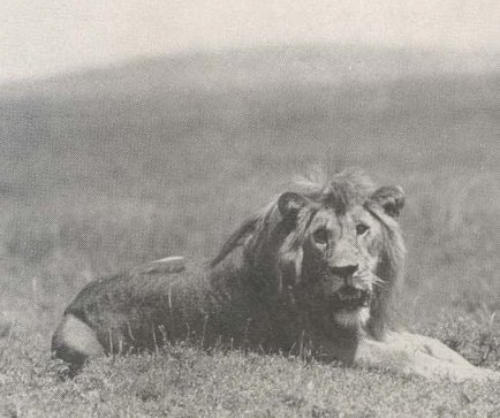
Goodbye forever?
Many interesting stories have been written about the performance of motor trucks under adverse weather and
road conditions, but to date relatively few are as fascinating as the recent safari by Cmdr. Attilio Gatti to the
"Mountains of the Moon" in British East Africa.
A BULLETIN issued by the Saturday Evening Post last spring carried the
heading "Gatti Couldn't Speak English, So He Wrote It." The Post continued:
"When the Italian-born explorer Attilio Gatti arrived in the United States in
1930 he had 19 well-chosen words at his command and 9 others not so well
chosen. He was recovering from blackwater lever, his 7th African Expedition
had just gone bust, and he was broke. Yet, in the years bridging that time
and the present, Gatti bas written dozens of books and hundreds of articles
in the English language.
His second article for the Post, 'Trial by Fire,' appears in the current issue."
(Mar. 12,1949) This is the Gatti who, in the following pages, tells the story of his eleventh venture into
Africa. The exploit will be told and retold in articles for the leading magazines and in detail in a book or
two to join the volumes on the "5-foot shelf' of adventure in which Attilio Gatti has unfolded his long
career devoted to exploration and travel in Africa.
In this booklet the author outlines, for International Harvester, the beginnings of this final venture and the
story of the eight MAIN CAMPS in British East Africa. The expedition completed this year was
sponsored by the Hallicrafters Company to test the outer boundaries of short-wave radio
experimentation. The trucks, a fleet of 8 bearing the famous Triple-Diamond emblem-were selected by
Gatti on the basis of his past experience with Internationals. For the duration of the expedition they were
serviced as necessary by the International Harvester branch at Nairobi, B.E.A.
Many of our readers will recall the glamorous "Jungle Yachts" of 1938-40-the elaborate trailers,
streamlined as units with International truck chassis, which served as the nucleus of the 10th Gatti-
African Expedition. In that supposedly "final" venture Commander Gatti and his gallant wife toured the
Belgian Congo. The Jungle Yachts, joined together in camp as a de luxe 5-room apartment on wheels,
served as headquarters while the expedition 's personnel sought out the secrets of the dim heart of
Africa. The story of that expedition was told in an International Harvester motion picture which bas been
shown to three million people, and also in various illustrated volumes written by the Gattis; Kamanda,
Killers AII, and South of the Sahara, published by McBride; Saranga, the Pygmy, serialized by the
Ladies' Home Journal and issued in book form by Charles Scribner's Song; Here is Africa,
Meditrrranean Spotlights, and Here is the Veld, published by Scribner's.
The adventures of the current expedition have also been recorded in motion pictures. A full-color film
produced by International Harvester is now ready for showing to dealers' audiences and to many types
of civic organizations on request.
Readers of the following account may be guided by the itinerary in the map
on pages 12 and 13, in which the explorer routes his party of fifty and their
complex equipment from disembarkation at Mombasa to the big-game
headquarters center at Nairobi. Short-wave radio enthusiasts around the
world, who listened intently for the call 1etters of the five Gatti-Hallicrafters
stations in Kenya, Tanganyika and Uganda, will recall the place-names of
the African camps. . . Kwale . . . Kilerna. . . Arusha . . . Narwa . . . Fort
Portal. . . Nanga Point. . . Nakuru . . . Destro Farm, Nairobi.
From there, as from all successive main camps, the expedition made numerous minor safaris to observe
and photograph natives, scenery and game; to hunt for fresh meat; and to follow a tip or hunch about
rare animals, strange ceremonies or a witch doctor's hideaway
There are mystic implications in the language of Africa for most stay-at-home Americans who are bound
by the trails of "civilization" and who take their foreign travels from the screen or printed word. For the
explorer and adventurer who has spent 15 years on African soil
the memories are personal and keen. They take him beyond the coastlines, across the Sahara from the
north, from the west deep into the Congo, from the eastern ports to the interior.
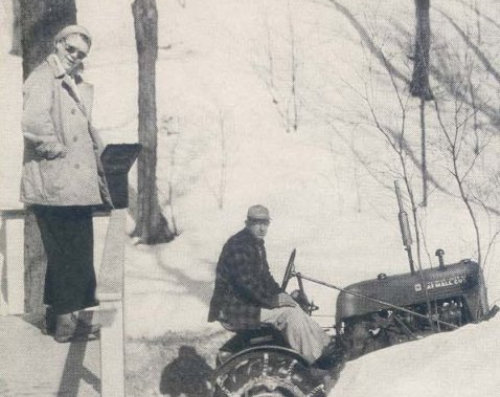
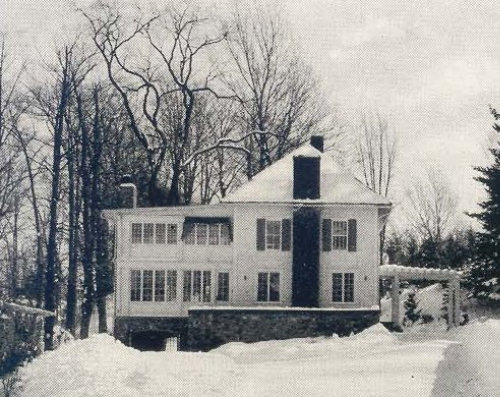
Commander Gatti became a United States citizen four years ago. He and his wife, American-born, have
established a permanent home on the U. S.- Canadian border at the top of Vermont. The setting, as the
accompanying pictures show, is a far cry from the equatorial jungle. The tiny Pygmies and the giant
Watussi warriors are far away. The crocodile- infested tropic swamp, the prowling lion, the elusive bongo
and okapi are of little concern to the settled natives of New England.
Can Gatti join with his untraveled neighbors and be content? He is certain
that he can-perhaps his wife is very certain. But Gatti failed in staying put
in 1938, and again in 1947. In 1956, after another 9-year cycle of inactivity
is complete, he will be only "sixty years older than when he was born"
(see next page). In that year-or any year, beginning now- in the cold white
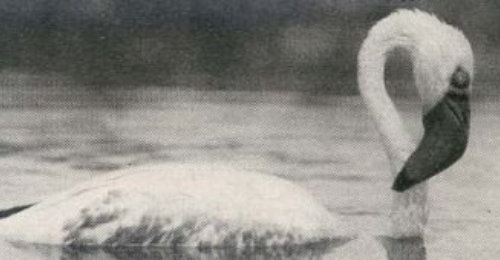
winter silence of Derby Line, Gatti may see, as in a dream, the hundred
thousand flamingoes in a flash of brilliant plumage rising from the soda-
saturated waters of Nakuru Lake.
And begin to plan his 12th Safari.


THE AFRICAN fauna offers
a startling treasure chest of
mammals, birds, fishes and
reptiles . Everyone knows
the zebra, of which there are
a score of varieties. Less
known are the quaggas, half
zebra, half wild ass, whose
last specimen in existance
we saw in South Africa; the
bongo, whose only live
specimen of the Congo
variety we captured in the
lturi; the okapi, of which we
discovered a new race only
six years ago.
From `Here is Africa`
by Ellen and Attilio Gatti,
published by Charles
Scribner's Sons.


LIONS WE COULD SEE
several times during the day in
the valley below US; and we
could often hear them at night,
giving their dramatic calls in
the distance, or prowling in the
vicinity of the camp.
From Great Mother Forest,
Charles Scribner's Sons, 1937,
following one of the earlier
ventures.