

Story by MIDWAY/KURE DX FOUNDATION found on old EUDXF site)
reprinted by PA0ABM
After returning from the 1996 Midway operation,
members of the AH4/AHØW team sensed the beckoning
of Kure Atoll (OC-Ø2Ø) as their next operation, just like
the mystical island of Bali Hai once summoned the
sailors of South Pacific to its romantic shores. The
Midway team had been alerted to an intense
DXpeditioning interest in Kure as reported by fish and
wildlife authorities as well as its rising status on the
European needs list according to the EU survey
published the first of 1997.
A joint operation was therefore proposed that would
include fish and wildlife scientists and the members of the
Midway-Kure DX Foundation's 1996 Midway team.
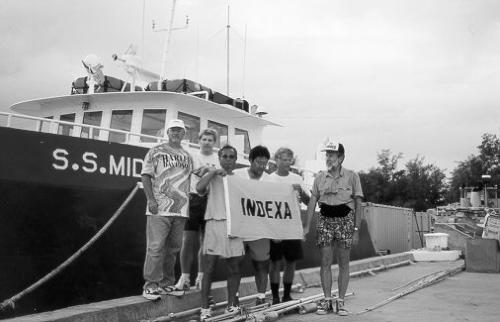
Ultimately, a group of 4 scientists would join Kimo Chun
KH7U, Andy Chesnokov UA3AB, Michael Goode N9NS,
Randy Martin KØEU, Burt Myers WØMY (ex WØRLX),
Erik Sjölund SMØAGD, Frank Smith AHØW/OH2LVG and
Yuji Yoshitani JA3IG/K1NT. Their expedition would take
them all back to Midway by aircraft and then to Kure Atoll
by ship, the S.S. Midway.
Upon arrival the DXpedition team was congratulated for making the journey to what geographers claim
is the remotest island on the earth. Kure's proximity to its nearest continental land mass is greater than
any other island in the world. It is also one of the most restricted pieces of real estate anywhere: "No
Trespassing" and "No Landing" signs surround the island, and navigational charts shows the entire atoll
as prohibited.
In fact, the only "legal" residents on Kure are the
Hawaiian monk seals and the Green sea turtles who must
share the islands with hundreds of thousands of ground-
nesting birds which include the legendary Gooney birds
(Laysan and short-tailed albatross), white fairy terns, the
Great frigatebirds, petrels, boobies, noddies, tropicbirds,
shearwaters, curlews, and plovers, to mention a few.
None of them ever protested the invasion of their territory
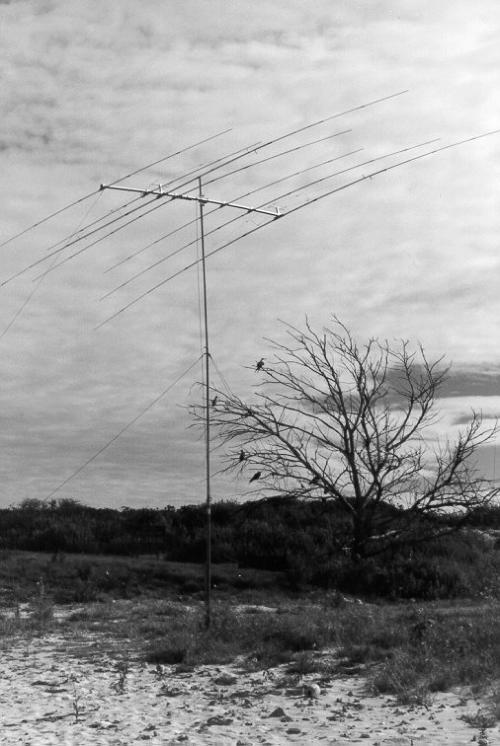
by these strange-looking DXpeditioners. In fact, the large
frigatebirds took an instant liking to the yagis!
After making nearly a dozen 4 mile over-the-reef zodiac
landings from the S.S. Midway to Green Island, the K7K
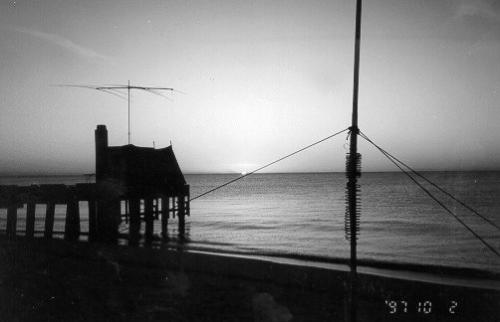
team immediately began the work of putting up four HF
stations, two on the western shore of the island and two
uphill. Antennas included Force-12 C-3's, Force-12 80
and 160 meter verticals, Force-12's new WARC-7
tribander, HF2V verticals, a Cushcraft A3WS and the
German-made Titanex 40-80-160 meter vertical. The
team also enjoyed the benefits of the SM¯AGD 20-
meter Special, a vertical quickly assembled by Erik
SMØAGD from the broken remnants of one of the
beams destroyed during the reef landing. The vertical
worked great, particularly on RTTY.
All four stations were quickly pressed into simultaneous operation, bands permitting. A week later the
team netted over 25,000 QSO's including 1100 on 160 meters. The team's objective to work Europe was
well accomplished with over 35% of the total QSO count being with European as well as some ME and
AF stations. Most of the European QSO's occured on 20, 30 and 40 meters, but the final two days of the
operation netted a fair number of European QSO's on 80 meters.
Propagation studies earlier provided by Ned Stearns
AA7A proved to be highly dependable to the K7K team.
However, the team experienced an
unpredicable and total black-out of propagation on all
bands on their third day of operating. Fortunately the
bands restored themselves after about 4 hours, much to
the relief of the team. It wouldn't take long to jump-start
the pileups after this brief blackout.
Sensitive to the ecological concerns of Kure, including
beaches covered with plastic and glass garbage that
continuously floats ashore, the K7K team undertook to
assist the fish and wildlife scientists with their clean-up
work. Teammembers, when not on-the-air, worked
side-by-side with the F&W personnel to clear several
meadows of a non-indigenous bush-weed that has
become a menace to Kure's ground-nesting birds.
The Kure team returned home with an unsolicited
invitation from the Fish and Wildlife authorities to
return with them during future inspection tours of Kure.
In anticipation of that, the team left some equipment in
storage on Kure.
Following Kure, the team returned for a 2-night, one-
day stay on Midway where they made approx. 3,000
QSOs as K4M before returning to Kauai and onward to
their respective homes. As chairman of the Midway-
Kure DX Foundation, Frank AHØW and Yuuji Yoshitani
JA3IG/K1NT also worked out an
arrangement with officials on Midway whereby two
permanent HF stations will be installed in Midway's
hangar to include two fully-equipped ICOM HF tions and Force-12, Cushcraft and other antennas. The
stations should be ready beginning the first of 1999. (Information about visiting and operating from
Midway can be obtained from:
oh2lvg@primenet.com or mkdxf@aztec.asu.edu).
On Kure's Green Island, on the very site of where the Loran antenna once stood, there is a monument
honoring the US Coast Guard's thirty-year work on Kure. On that monument is a plaque that reads: "You
can always leave Kure Island, but Kure Island will never leave you." Those were the feelings of all who
participated in the September-October 1997 EUDXF-sponsored DXpedition to Kure K7K. The K7K Kure
team wishes to express it's appreciation to EUDXF and its officers for support with this DXpedition as
well as for all others so generously funded in past years by EUDXF.
QSL both the K7K and K4M operations via:
Bob Johnson KE7LZ
5627 West Hearn Road
DXpedition to Kure (K7K) and Midway (K4M)



DXpeditions 02





