DXpeditions 01
This article originally appeared in the January 2011 issue of EUDXF.
Written by Andy Glaeser, DL9USA and Jan Harders, DJ8NK
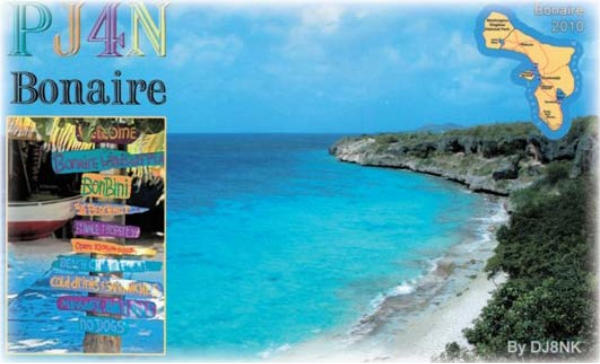
Bonaire PJ4
Andi DL9USA and Jan DJ8NK formed one of the teams on Bonaire for celebrating the political change
of status in mid October 2010. Of course it was a special thrill to participate, when a „new one” for
DXCC was created. For the DX chaser it was surely an even greater thrill, because 4 new entities were
created in the Caribbean Sea the same day, which was the 10.10.10, the pile-up was immense.
Only during this summer we learned, that the
10.10.10 would be the actual date of the
change, after a public vote a few years back
had already demanded that step. Curacao PJ2
and St.Maarten PJ7 had decided to become
independent countries under the Netherlands
crown as Aruba P4, ex PJ3 is already since
1986. Bonaire PJ4 , St. Eustachius PJ5 and
Saba PJ6, now the so called BES-islands, are
not fully independent, but became special
municipal districts within the Kingdom of the
Netherlands.
The DXCC desk took a little while before they
announced their decision concerning the DXCC status of these islands. The former Netherlands Antilles
counted as 2 separate DXCC entities: Curacao/Bonaire and St.Maarten/St.Eustacius/Saba. Those 2
entities were „deleted” and 4 „new ones” PJ2, PJ4, PJ5/PJ6 and PJ7 were added to the DXCC list,
which now totals to 340 current entities.
In planning and preparation of the trip we
contacted one of the permanent licensed hams
on Bonaire, Peter PJ4NX. He helped in all kind
of matters, in particular to find a QTH, which we
could rent, to find a car hire and to address the
right persons at the licensing office, so that we
finally could book our flights with KLM.
Generally speaking it is possible to work under
CEPT agreement, but we did not really fancy
the idea to use such long calls like
PJ4/DL9USA or PJ4/DJ8NK. So we sent
applications to the authorities and finally PJ4I
and PJ4N were assigned to us. Jan got his
license very quickly but Andi had to wait until
one day before his flight, but then both of us were granted the special calls for the period of 10.10.10 to
22.10.10. PJ4 calls with a 2-letter-suffix are only issued to local hams, whereas calls with
1-letter-suffix are only issued for special events and for max. 48 hours, such as contest weekends.
But for this extraordinary event the very
generous and helpful licensing office made an
exception: PJ4I and PJ4N was valid for 12
days, with similar periods for the other PJ4
guest calls. Because Jan could
only fly into Bonaire on 15. Oct., Andi and his
YL flew alone on 08. Oct. The house, which
they had rented for a week, was situated in a
mere living area, with many neighbours all
around.
The garden was very small and covered with
shrubs and bushes. Therefore there was no
chance to put up a 5-band Spiderbeam, but
instead only a home made vertical for 30/40/80
meter. On the 9th of October this station was tested for a short time using the call PJ4/KP2I
[PJ4/DL9USA was too long and PJ4I was not valid, yet]. The next day the actual operation started under
PJ4I. Using the tuner that vertical could be matched on 10 to 40 m. It was impossible to work on 80 m,
because the QRN was over S9 at any time, it was the rainy season with thunderstorms all around. The
600 W PA was not used, just to be nice to the neighbours who wanted to watch the television programs
HI HI. With 100 W the signal was very weak in Europe but loud in USA, so during the first week mainly
north and south America were worked, which was an advantage for the second week, because they
were worked already, resulting in less QRM HI.
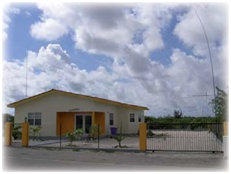
On the 15th there was hardly any activity, because we had to
move to the other house, bigger, with a large garden and no
neighbours. This house had been used by 3 Dutch hams under
the call PJ4W. These 3 hams flew home with the same aircraft
which brought Jan to the island. So the change over
to that house was very convenient. In tropical areas there is no
twilight, minutes after sunset it is pitch dark, the „light is switched
off” at 18:30 local time. That did not give us much time for
antenna work outside, but inside we could install the 2 stations,
two K3s, two 600 W PAs with bandpass filters, coax cables
through the windows and then a good glass of local red wine on
the veranda at 28°C, good life.
Next morning we installed a 5-band Spiderbeam (10–20 m) and two verticals for the low bands. Peter
PJ4NX had installed a 5-band Optibeam a week earlier, which
had high SWR and no resonance at all on 15 and 20 m. Quick
correspondence with Tom DF2BO showed us the correct way for
repairing, but we had to take down the beam, which is not all
that easy. Three loose bolts were tightened and then that beam
was a smashing performer. Then we started the operation with
two stations simultaneously.
PJ4N worked SSB and RTTY and PJ4I had the CW part. It all
went very well and satisfactory, with one big surprise: the
unexpected 10 m openings into Europe on two consecutive
days, which brought more then 1,200 QSOs into the log. After
one week, on the afternoon of the 22nd we had to dismantle the
stations, take down all antennas, pack everything and get ready for the return flight to Europe in the
evening. We donated the Spiderbeam to Peter PJ4NX, who was
just about to set up a local club
station, which will be operational shortly.
Some more infos about the other ham activities on Bonaire.
Prior to the operations some „irritations” were experienced,
because from a kind of dominating person a WEB page was set
up, which attempted to force all hams, who intended to be active
on Bonaire, to become members of one (not existing) team,
which should operate under ONE (not nominated) call, use ONE
common log and W3HNK as the only QSL manager. Naturally
this „steamroller mentality” had no chance to succeed. Instead –
spread over the island – seven QTHs were in use, some of them
with multiple stations. Mutual consideration, agreements and
respect was needed to avoid interference and overlapping pile-ups, which in most of
the cases worked out well. We visited all the other sites and enjoyed meeting the other hams.
Two active hams live permanently on Bonaire: Hans PJ4LS and Peter PJ4NX, ex PA3CNX.
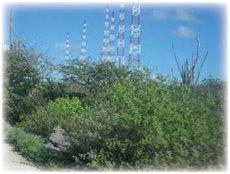
The call PJ4W was operated with a brand new FT5000 at the antennas of Radio Netherlands during the
hours without broadcasting. Eight 145 m high towers hold directive curtain antennas with a gain of 21
dB. Fantastic. The call PJ4D was used by a group of 4 Ws and 3 OMs from PA were QRV under PJ4B
from a contest station (to be rented) up on the highest hill in the north of the island. Additionally the QTH
of PJ4/W9NJY and the one of PJ4I/PJ4N must be mentioned. Bonaire with appr. 16,000 inhabitants
and an area of 288 km² is not really a large island, but very lifely and colourful. Several languages are
spoken: Dutch, English, Spanish and Papiamentu. The official currency is at present the NAF
(Netherland Antilles Florin) or in short „Guilder”, but they will change to US Dollar by 1st Jan 2011. When
going shopping in a super market or paying in a restaurant the bill will show 3 currencies: NAF, USD and
EUROs, all three of which the change is always given in NAF. Apart from the good looking locals many
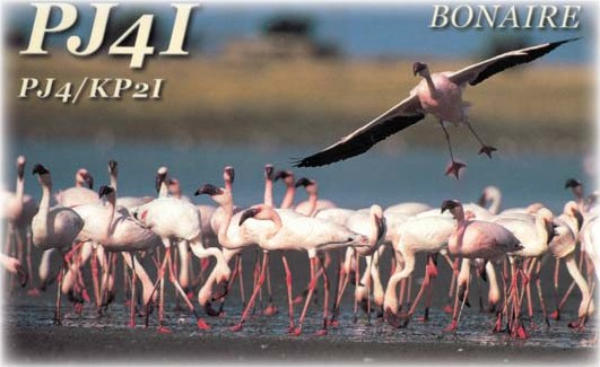
different kinds of animals live on the island, such as big lizzards, lguanas, parrots, flamingos and plenty
of seagals, and many wild donkeys.
Nobody needs them anymore, they are replaced by cars and tractors. Not to forget to mention the warm,
sunny weather and the crystall clear water with coral reefs, a paradise for snorkling and scooper diving.
If somebody plans to operate from Bonaire, please contact Peter PJ4NX, who will assist with house and
car rental.
Finally we wish to express our sincere thanks to all members of EUDXF for their generous financial
support.
VY73 de Andi DL9USA and Jan DJ8NK
A man should keep his friendship in constand repair (Samuel Johnson (1755).
DXpedition to Bonaire PJ4